






Allergies
Hives (Urticaria)
The medical name for hives is urticaria [ur-tuh-KAIR-ee-uh]. Hives are a common sign of an acute allergic reaction. Hives can also occur due to other causes, including a viral or bacterial infection. Hives may also develop due to no known cause or spontaneously. About 1 out of 5 people experience hives at some point during their lives.1
What Are Hives (Urticaria)?
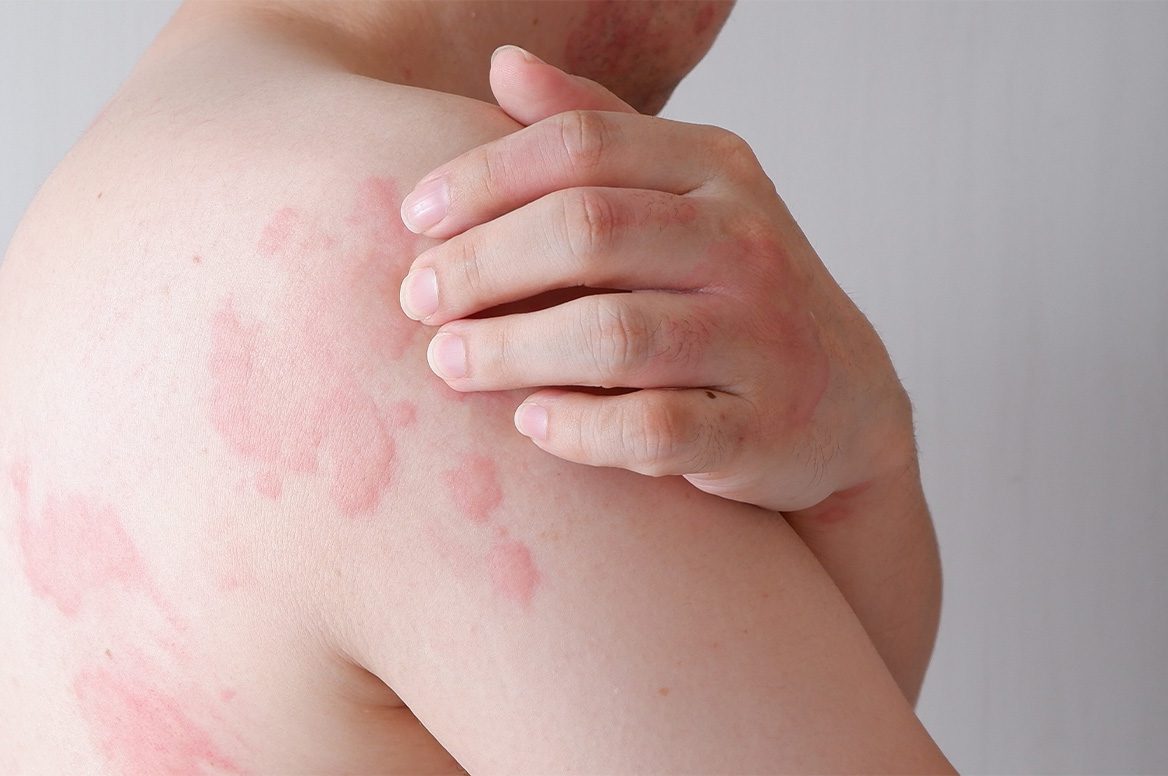
Hives are raised, itchy bumps (called welts or wheals) on the skin. Hives can be triggered by allergic reactions, skin irritation, infections, medical conditions, or have no known cause.
Hives can occur alone as the single symptom of an allergy reaction, or be one of several allergy symptoms. Hives can occur during severe allergic reactions known as anaphylaxis [anna-fih-LACK-sis].1
Mild to intense itching is a common symptom of hives. Other symptoms include skin swelling, burning, and stinging.1,2
Call your doctor if:
- Your hives are making you uncomfortable
- You have never experienced hives before
Go to the emergency room or call 911 if:
- Your hives are severe and cover a large area of your body
- You have other symptoms such as trouble breathing
What Do Hives Look Like?
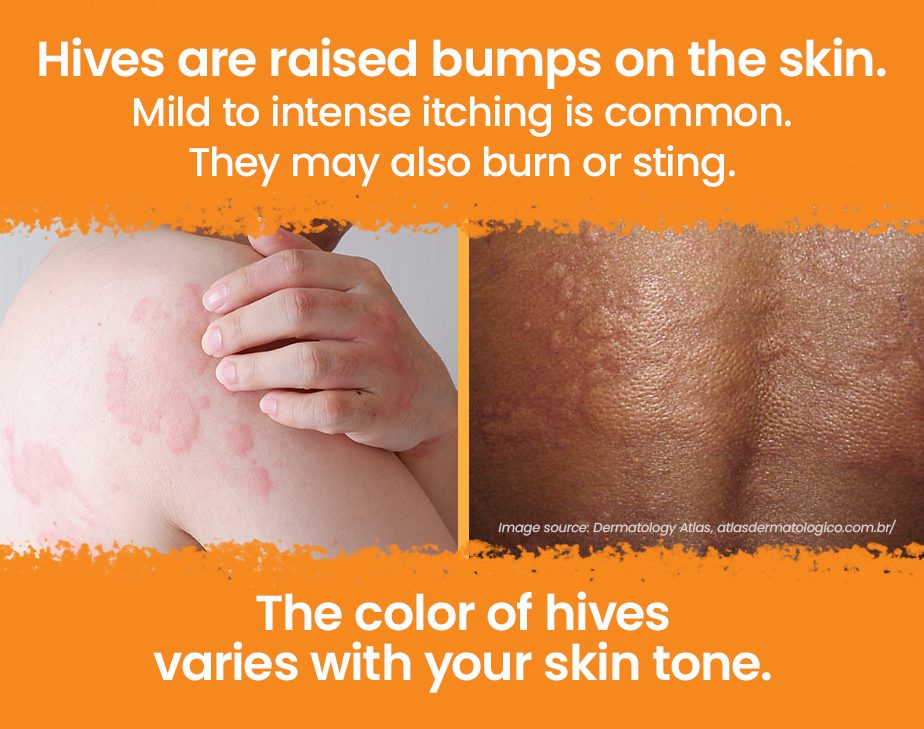
Hives can resemble bug bites or other rashes. Hives can be small or large and can occur anywhere on the body. Hives may change shape and move around different areas of your body. They usually appear and disappear suddenly and may reappear over short periods of time. The center of the hive will become a lighter color when pressed (blanching). The welts from hives may join together, forming larger areas (plaques).1,2
The color of hives varies with your skin tone. People with light or medium skin usually have red or pink hives. People with brown or black skin usually have hives of the same color as their skin, or slightly darker or lighter than their natural skin tone.3
What Are the Different Types of Hives?
Acute hives often occur as an allergic reaction to an allergen (substance that causes an allergic immune reaction). Acute hives last a few hours to a few days or less than 6 weeks. Hives form because of the release of histamine by the mast cells (immune cells) in your skin, in response to allergens or viral infections.1 There are a few other sources of inflammation in the body that can lead to short-term hives of a few days to even a few weeks.
Contact hives are a form of acute urticaria. The hives occur at the site of contact with the allergen or irritating substance, up to 1 hour after the exposure. Contact hives usually resolve within a day.4
Chronic hives (chronic urticaria) occur almost daily and by definition last for more than 6 weeks. Chronic hives may be caused by infections, a problem with the immune system, or as result of other medical conditions such as lupus or other autoimmune conditions. Chronic hives are rarely caused by allergies to a food or environmental trigger. Allergists generally do not recommend allergy testing for chronic hives.
Most chronic hives have no known cause and just happen for unknown reasons. This is called chronic spontaneous urticaria (CSU). With CSU, hives come back again and again and are unpredictable.
Some people have chronic hives that are triggered by known physical factors. This is called chronic inducible urticaria (CIndU). Triggers for CIndU include cold, heat, pressure, vibrations, exercising, sweating, and UV light from sun exposure (very rare).1,2,5
It is possible for a person to have CSU (recurring hives with no known cause) and CindU (hives that happen when exposed to a known trigger).
What Triggers Hives?
Several factors, medical conditions, irritants, and allergens can trigger hives including:2,4
- Food allergies
- Pet dander
- Airborne allergens, such as pollen
- Medications, such as antibiotics (especially penicillin and sulfa) or non-steroidal painkillers (aspirin and ibuprofen)
- Dyes in medications
- Insect stings or bites
- Physical stimuli such as pressure, cold, heat, vibrations, exercise, or sun exposure
- Latex
- Fragrances and flavorings
- Detergents and disinfectants
- Blood transfusions
- Bacterial infections, including urinary tract infections and strep throat
- Viral infections, including the common cold, infectious mononucleosis, and hepatitis
- Some plants, such as poison ivy, oak, and sumac
- Medical conditions, especially autoimmune conditions such as lupus
Despite all the known potential triggers, sometimes hives may develop due to unknown causes.5
How Do Doctors Diagnose Hives?
Your doctor will look at your skin and will ask you about your recent medical history.
For acute hives, the doctor may do allergy testing, including skin tests and blood tests. Allergy testing can be used to identify the allergens that may be triggering the reaction.1
For chronic hives, your doctor may run other blood tests, ask you to do symptom tracking, and rely on photos, medical history, and physical exam to make the diagnosis.
What Are the Recommended Treatments for Hives?
Many cases of hives are harmless and go away on their own. This is typical of an untreated allergic reaction, so long as there is no further exposure to the trigger. Applying cold compresses, taking cool showers, or wearing loose-fitting clothing may also help to reduce the symptoms.1
Acute hives treatment
For cases of acute hives, non-drowsy or less drowsy antihistamines are the preferred immediate treatment. A topical corticosteroid [kor-tick-OH-stair-ROID] may help the hives go away faster. Using topical creams is not a preferred strategy for hives that are recurring, even in the short term.
If hives occur as part of a serious allergic reaction (known as anaphylaxis), the allergic reaction should be treated immediately with epinephrine, and antihistamine can be given after epinephrine is given.1
Systemic (oral) corticosteroids such as prednisone are generally not recommended:
- These types of steroids have a risk of serious side effects
- There is potential for rebound worsening of hives
Chronic hives treatment
Experts updated the guidelines for treating chronic hives in 2026:6
Step 1: The first recommended strategy to treat chronic hives is with non-drowsy or less drowsy antihistamines. These antihistamines are known as second-generation antihistamines, and they have fewer side effects than first-generation antihistamines. Start with the standard (e.g., what the box/bottle says) dose.
Second-generation antihistamines to treat chronic hives include:
- Desloratadine (Clarinex) available through prescription
- Loratadine (Claritin) and fexofenadine (Allegra) available over the counter
Although cetirizine (Zyrtec) is a second-generation antihistamine, it may cause drowsiness, so new guidelines suggest using the less sedating options above. Hydroxyzine (Vistaril) is a prescription first-generation antihistamine that has been used to treat chronic hives. This medicine causes significant side effects, so new guidelines recommend using a second-generation antihistamine instead.
Step 2, if the hives do not improve after Step 1: If the hives do not improve, the dose and/or the frequency of the second-generation antihistamine can be increased to a maximum of 4 times the once-daily dose. For example, if the box says to take one pill once a day, it can be increased to 4 pills once a day OR one pill every 6 hours (which would be 4 times per day). Talk with your doctor or pharmacist to see if this is the right option for you.
The guidelines suggest against topical corticosteroids (like steroid creams or ointments) and do not recommend oral corticosteroids (like prednisone). This includes long-term continuous dosing or repeated bursts.
The guidelines also suggest not using UV light therapy.
Step 3, if antihistamines are not controlling hives: If increasing the antihistamine dose (up to 4 times) does not work, a short burst of oral corticosteroid (prednisone) may be suggested. This should be used for less than 7 days and come with a referral to a chronic urticaria specialist.
Advanced therapies may be used to treat chronic hives. The guidelines recommend adding a standard dose of omalizumab (in addition to antihistamines). Other treatments that may be tried are dupilumab or remibrutinib.
- Omalizumab (known as Xolair or Omlyclo) is approved by the Food and Drug Administration (FDA) for the treatment of CSU in people aged 12 years and older. It works by attaching itself to the IgE antibodies to help prevent your body from overreacting and producing hives. It is an anti-IgE medicine.7
- Dupilumab is approved by FDA for the treatment of CSU in people aged 2 years and older. DUPIXENT works by inhibiting proteins responsible for inflammatory signals in your body, controlling the inflammation that leads to hives.8
- Remibrutnib (Rhapsido®) is an oral medicine approved by the FDA for the treatment of CSU in adults. It works by blocking the release of histamine and other inflammation mediators that cause hives.9,10
A recent study (called a network meta-analysis) compared all the different types of chronic urticaria treatments against one another. It reviewed treatments from the past, presently available, and those that are under development. The results suggested that these options worked best for urticaria flares, improving quality of life, and had strong safety data in terms of side effects:11
- Standard doses of omalizumab (Xolair) and remibrutinib (Rhapsido) are among the most effective drugs with favorable safety profiles
- Dupilumab (Dupixent) improves itch and wheals but it is uncertain if it improves quality of life
It’s important to talk with your dermatologist, allergist, or primary care doctor about the benefits and risks of treatment options. There are many ways to try to treat chronic urticaria, most of which depend on what you may want or prefer.
How Can I Prevent Hives?
Since acute hives can be caused by an allergic reaction, the best way to prevent them is to avoid being exposed to allergens you are allergic to. The results of allergy tests will help you know which allergens trigger your hives. If you are allergic to animals, plants, or pollen, take a bath, and change your clothes after you have contact with one of these allergens.1,12
Preventing chronic hives is more difficult and relies on a combination of avoiding or reducing known triggers and taking medication.
Are Hives Contagious?
Hives are not contagious. However, when you develop hives after being exposed to allergens such as secretions from poison ivy, you can spread the allergen if you don’t wash it off your skin.1
Acknowledgements
This content is developed independently by the Asthma and Allergy Foundation of America (AAFA) and made possible by contributions from Novartis, Sanofi, and Regeneron.
Med Communications, Inc. assisted with development and review of medical content.
Medical review: September 2025 by Alison Ehrlich, MD, MHS and Matthew Greenhawt, MD, MBA, MSc
Editorial review (updates to include new practice parameters): September 2026 by Melanie Carver, Chief Mission Officer
Closed
References
- Cleveland Clinic. (2022, October 14). Hives. My Cleveland Clinic. Retrieved September 18, 2025, from: https://my.clevelandclinic.org/health/diseases/8630-hives
- American College of Allergy, Asthma and Immunology. (2018, July 11). Hives. Retrieved September 19, 2025, from: https://acaai.org/allergies/allergic-conditions/skin-allergy/hives/
- American Academy of Dermatology. (2024, May 30). Hives: Signs and Symptoms. Retrieved September 19, 2025, from: https://www.aad.org/public/diseases/a-z/hives-symptoms
- Vethachalam S, & Persaud Y. (2023, July 31). Contact Urticaria. In StatPearls. StatPearls Publishing. Retrieved September 18, 2025, from: https://www.ncbi.nlm.nih.gov/books/NBK549890/
- Dabija D, Tadi P, & Danosos GN. (2023, April 17). Chronic Urticaria. In StatPearls. StatPearls Publishing. Retrieved September 18, 2025, from: https://www.ncbi.nlm.nih.gov/books/NBK555910/
- American College of Allergy, Asthma, Immunology. (2026, June 01). Chronic Urticaria Guidelines: 2026 AAAAI/ACAAI Joint Task Force (JTF) on Practice Parameters GRADE and Institute of Medicine-based recommendations. Retrieved September 25, 2026 from: https://college.acaai.org/wp-content/uploads/2026/06/JTF-CU_guideline-2026-06-01-For-Distribution.pdf
- Genentech, Inc. (2024). XOLAIR Prescribing Information. http://www.gene.com/download/pdf/xolair_prescribing.pdf
- (2025). DUPIXENT® Prescribing Information. https://www.regeneron.com/downloads/dupixent_fpi.pdf
- (2025). Rhapsido® Prescribing Information. https://www.novartis.com/us-en/sites/novartis_us/files/rhapsido.pdf
- American Academy of Dermatology. (2025, May 22). Hives: Diagnosis and Treatment. Retrieved September 19, 2025, from: https://www.aad.org/public/diseases/a-z/hives-treatment
- Chu, A. W. L., Oykhman, P., Chu, X., Rayner, D. G., Bhangal, S., Dam, A., Xu, J., Sheikh, J., Trayes, K. P., Frazier, W. T., Lang, D. M., Beck, L. A., Mathur, S. K., Waserman, S., Thabane, L., Asiniwasis, R. N., Runyon, L., Moellman, J., Oliver, E. T., Chan, J., … Chu, D. K. (2022). Comparative efficacy and safety of biologics and systemic immunomodulatory treatments for chronic urticaria: Systematic review and network meta-analysis. Journal of Allergy and Clinical Immunology. Advance online publication. https://doi.org/10.1016/j.jaci.2025.06.004
- Mayo Clinic. (2023, October 27). Hives and angioedema. Retrieved September 19, 2025, from: https://www.mayoclinic.org/diseases-conditions/hives-and-angioedema/symptoms-causes/syc-20354908